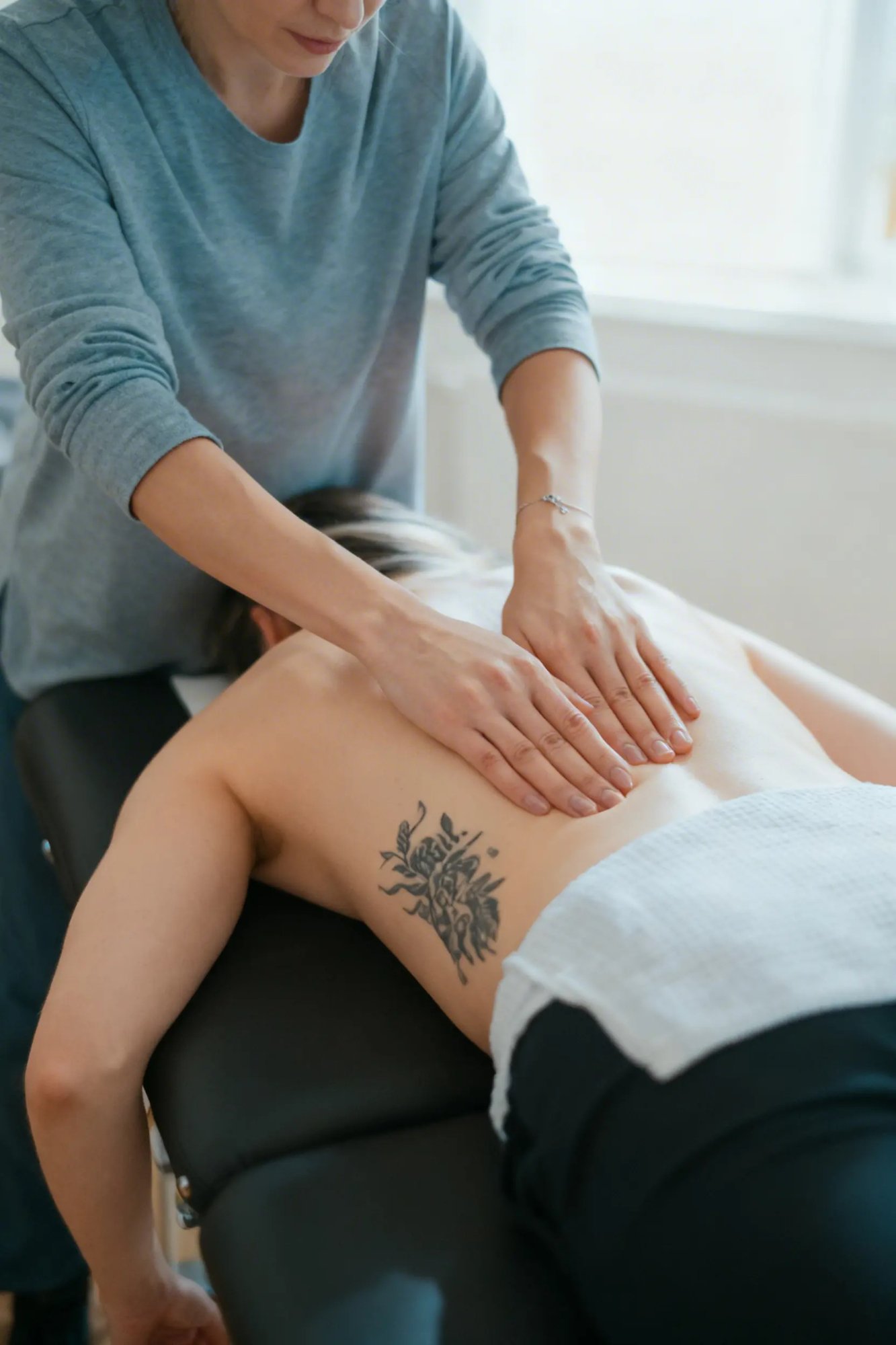
Back Massage Bristol: When the Back Is Not the Problem
Most back massage treats where you feel it. The Physology approach traces back pain to where it starts, which is almost never in the back itself. For patients in Bristol, that difference changes everything about what treatment can achieve.
20+Years Clinical Experience
5 YrsEverton FC Medical Team
30-50%Pain Reduction Session One
Back massage is the most sought-after treatment for back pain in Bristol, and for an obvious reason. The back hurts. It makes intuitive sense to treat the back. But if you have had back massage before and found the relief fades within days, that intuition, while completely understandable, is pointing in the wrong direction.
Chronic back pain is almost never a back problem. The back is where the pain is experienced. The origin is almost always somewhere else in the Fascial system: the pelvis, the diaphragm, the hamstring chain, the deep hip flexors, or the thoracolumbar Fascia that connects the whole posterior structure. When those areas are restricted and the back compensates, treating the back produces temporary relief at best. The compensation pattern remains. The pain rebuilds.
At Physology, based at Cavendish House, 15 Whiteladies Road, Clifton, Bristol BS8 1PB, our back massage approach begins with a Fascial assessment that maps the whole system before any hands-on work begins. We identify the source of the back pain, not just its location. We serve patients from across Bristol, Bath, Keynsham, Peasedown St John, Paulton, Shepton Mallet, and the wider region who have tried back massage, physiotherapy, and chiropractic and need an approach that addresses why their back pain keeps coming back.
What Is Fascia and Why Does It Drive Back Pain?
Fascia is the connective tissue system that explains why back pain so often resists treatment. The thoracolumbar Fascia, the broad sheet of connective tissue covering the lower and mid back, is one of the most densely innervated Fascial structures in the body. When it becomes restricted, it does not just create mechanical stiffness. It actively generates pain signals. It changes how the muscles attached to it can function. And it responds to restrictions from elsewhere in the body by accumulating tension that no amount of back massage will reach.
The research is definitive on this. Helene Langevin at Harvard Medical School found that in people with chronic low back pain, the thoracolumbar Fascia is measurably thicker than in pain-free subjects, with significantly reduced movement between layers. Paul Hodges at the University of Queensland has shown how changes in breathing mechanics, driven by Fascial restriction around the diaphragm, directly alter spinal stability and create the conditions for chronic back pain. These are not marginal findings. They explain why back massage alone produces such limited long-term results.
Every patient who comes to Physology with back pain receives a full Anatomy Trains assessment before any hands-on work begins. We use this to map exactly how the Fascial system is holding the back in its current state of restriction and compensation. We identify where the primary drivers are: the pelvis, the diaphragm, the posterior chain, the psoas, or a combination. We trace the compensation pattern from its origin to the back, where you feel it.
The treatment then addresses the primary restriction directly, using deep Fascial release and back massage techniques together, working through the connected lines in sequence. The back is treated as part of the whole-system pattern rather than in isolation. Patients typically notice a 30 to 50 percent reduction in back pain in the first session. Most reach full resolution within four to eight sessions with consistent improvement throughout.
Back Massage, Bristol
Back pain that keeps returning after massage is almost always driven by a Fascial restriction elsewhere in the system. Finding and treating that source is what produces change that holds.
Conventional Back Massage vs the Physology Approach
Conventional approach
The Physology approach
Works on the back muscles
Works on the Fascial chain driving tension into the back
Treats where the pain is
Finds where the pain originates, which is rarely in the back itself
Relief lasts hours or days before tension rebuilds
Lasting reduction when the Fascial source is directly released
No assessment of connected structures
Full assessment of pelvis, diaphragm, posterior chain, and hip flexors
No understanding of why pain keeps returning
Clear explanation of the restriction pattern and how to resolve it
Session-by-session management
Structured resolution over 4 to 8 sessions with clear progress each time
A Closer Look at How Your Back Pain Really Looks
This dissection clip shows what restricted Fascia looks like at the site of pain. For anyone whose back pain has been described as muscular, structural, or unexplained, this is the tissue that conventional back massage and physiotherapy typically do not assess. When the restriction is addressed directly, the change in how the back feels is immediate and measurable.
Anatomy Trains dissection series, showing Fascial tissue at the site of restriction
The thoracolumbar Fascia is one of the primary Fascial structures involved in most back pain presentations. When you understand what it looks like in a restricted state and what happens to the structures compressed within it, it becomes clear why treating the muscles alone produces only temporary relief.
What Types of Back Pain Respond to Fascial Treatment?
Our Fascial back massage approach in Bristol addresses the full spectrum of back pain presentations. Lower back pain is the most common, and it is also the presentation where the Fascial drivers are most consistently found away from the symptomatic site, in the pelvis, the hamstring chain, or the diaphragm. Mid-back and thoracic pain, which often presents as a deep, persistent ache between the shoulder blades or across the thoracic spine, almost always involves thoracolumbar Fascial restriction combined with anterior chain shortening. Upper back and neck pain that originates in the back responds particularly well when the Lateral Line and Superficial Back Line are assessed as a whole rather than treated segment by segment.
We also see patients with sciatica, sacroiliac joint pain, and the post-surgical back pain that has persisted despite technically successful procedures. In each of these presentations, the Fascial assessment reveals compensation patterns that have been maintaining the pain long after the original structural problem was addressed.
Back Massage in Bristol
Physology is located at Cavendish House, 15 Whiteladies Road, Clifton, Bristol BS8 1PB. We see patients seeking back massage from across Bristol, Bath, Midsomer Norton, Radstock, Frome, Wells, Glastonbury, Shepton Mallet, Trowbridge, and the wider Somerset, Avon, and Wiltshire area. For anyone who has searched for back massage Bristol, back pain treatment Bristol, or lower back pain specialist Bristol and is specifically looking for an approach that addresses the root cause rather than managing symptoms, our Fascial assessment process is designed to find what has been missed.
Initial consultations are two hours. Follow-up sessions are typically sixty to ninety minutes. We work with a focused patient list rather than a high-volume model, ensuring each session delivers the depth of assessment and treatment the individual situation requires.
What Patients Say
★★★★★
"None of them could identify what was wrong and none of them helped. Once I met James and Physology, it was literally the first session. I finished in just a few weeks and have lived pain free from that ever since."
Alger — Lower back pain since teens
Pain free. Has been ever since
< class="ts-dot active">
Your Back Massage Consultation in Bristol
Your first session at Physology in Bristol is two hours. More than any other pain presentation, back pain benefits from a long first session because the drivers are almost always not in the back itself. Finding them requires a proper history and a whole-body Fascial assessment. Patients travel from across Bristol, Bath, and the surrounding area for this consultation because it provides the explanation that years of shorter appointments have not.
1
Your Full Back Pain History
We start with your complete history: every episode, every treatment, every pattern. Back pain histories almost always contain the clues that reveal the original Fascial restriction and show how it has spread through the system to produce the current presentation. We take the time to hear all of it.
2
Whole-Body Fascial Assessment
Using the Anatomy Trains framework, we assess your posture and movement across the whole system. For back pain specifically, we look at the pelvis, the diaphragm, the posterior chain, and the deep front line as well as the back itself. The assessment maps how all of these connect to produce your specific pain pattern.
3
Seeing Your Back Pain Clearly
By the end of the assessment, you will understand your back pain in a way that most people never get the opportunity to. You will see where the restriction actually originates, how it has driven the compensation pattern that has accumulated over time, and why previous treatment has produced the results it has. This clarity is itself a measurable moment for most patients.
4
First Hands-On Back Treatment
We treat in the first session, targeting the primary Fascial restriction with back massage and Fascial release techniques. We typically see 30 to 50 percent reduction in back pain in the area we work on. Most patients reach full resolution within four to eight sessions with clear, measurable improvement in each one.
5
Your Clear Path to a Pain-Free Back
You leave with a complete understanding of your back pain pattern, a structured treatment plan addressing it in sequence, and a realistic picture of what resolution looks like for your specific situation. No guesswork and no open-ended course with no defined outcome.
Common Questions
Back massage reduces muscle tension and improves circulation in the back. If the driver of your back pain is Fascial restriction in the posterior chain, the diaphragm, or the deep hip flexors, working on the back muscles addresses the consequence rather than the cause. The relief is real but temporary because the restriction generating the tension has not been treated.
We begin with a whole-body Fascial assessment using the Anatomy Trains framework before any hands-on work. We identify where in the connected system the primary restriction is sitting, map how it connects to your back pain, and then apply treatment directly to the source as well as the back itself. This is what produces the lasting change that back massage alone cannot achieve.
Bristol Fibromyalgia & Back Pain Clinic
Ready to Find Where Your Back Pain Really Starts?
A Physology back massage consultation in Bristol gives you a Fascial assessment, a clear map of what is driving your back pain, and measurable improvement from the first session. Serving Bristol, Bath, and the surrounding area.
P.S. If back massage gives you relief that does not last, the source of the tension is outside the back. Get in touch and describe how your back pain behaves, what makes it worse, and what has helped temporarily. That pattern tells us where in the system the origin is most likely sitting.